

Bryophytes
The Science Of Haircap Moss | Habitat, Characteristics, Distribution & Reproduction

Haircap Moss is the common name for the moss species ‘Polytrichum commune’ but is also known as ‘Hairy Cap Moss, Hair Moss, Common Hair Moss, Great Goldilocks or Common Haircap Moss. In this article, we will cover the scientific name, taxonomy, habitat, distribution, physical characteristics, internal structure, and reproduction strategies of this moss.
Got a bank that washes out? Haircap is the tallest species we carry and the one that holds soil. Use it on slopes, streambanks and path edges, and mood moss between stepping stones. Indoors its upright stems read as a miniature forest, which is why it is also stocked terrarium grade.
1. Scientific Name
The scientific name for Haircap Moss is Polytrichum commune.
2. Synonyms
Haircap moss is the most used common name for Polytrichum commune, but other synonyms of this moss species are;
- Hairy Cap Moss
- Common Haircap Moss;
- Great Goldilocks;
- Common Hair Moss; or
- Hair moss.
TIP: Haircap is the tallest moss we carry, and that height is the point of it. Upright shoots and a dense mat make it the species for erosion control: banks that wash out in heavy rain, streambanks, and path edges where lower moss slides. Buy live haircap moss.
3. Taxonomy
The taxonomic classification of Haircap Moss (Polytrichum commune) is:
- Kingdom: Plantae
- Division: Bryophyta
- Class: Bryopsida
- Order: Polytrichales
- Family: Polytrichaceae
- Genus: Polytrichum
- Species: Polytrichum commune
4. Habitat
This moss can be found in moist forests, bogs and wetlands, urban areas (especially in moss lawns), Heathlands and open woodlands, and the alpine and arctic tundra.
4.1 Moist Forests
In the dappled light of moist forests, you can often find Haircap Moss because these forests have high humidity and relatively stable temperatures. This offers consistent moisture levels which is required for Haircap Moss to thrive.

This moss often forms lush green mats on the forest floor and around the bases of trees or on fallen logs. It is important for the local environment because it decomposes organic matter and recycles the nutrients of a forest. Besides that, it also retains high concentrations of water, helps regulate microclimates, and supports the (micro)fauna.
4.2 Bogs and Wetlands
The bogs and wetlands are another place where you can find this moss species. The waterlogged soil and acidic conditions make it difficult for other plants to survive, but not for this moss species. It loves these conditions, and, through the formation of peat, is an important part of the local ecology. It locks away carbon in the peat which plays a significant role in climate regulations.
4.3 Urban Areas
The urban areas are not the natural habitat of Haircap Moss but this moss has been widely adapted by gardeners and moss enthusiasts. Landscapers often buy live Haircap moss for green roofs, moss lawns, or as part of a decorative piece. This moss has been well adapted and spread on its own through urban areas and can now be found in parks and shaded but moist areas of cities and towns.
-
 Haircap Moss – Landscaping Grade | Tall Open-Shade GroundcoverPrice range: $24.95 through $10,249.95


4.4 Heathlands and Open Woodlands
Heathlands and open woodlands are other habitats where it can thrive. These places are often open and the soils are usually acidic soil; so perfect for moss. In heathlands, it supports directly and indirectly the local wildlife as a food source, as a hiding place, or by preventing soil erosion. By forming dense mats, it protects the soil and creates a habitat where small creatures and insects can live.
4.5 Alpine and Arctic Tundra
In the colder regions of the world (especially in the alpine and arctic tundra), Haircap Moss shows how well it can adapt to extreme conditions. It can withstand low temperatures, and short growing seasons, and thrives, as a pioneering plant, on nutrient-poor soils.
Here too it forms extensive mats, insulates the ground and provides protection for underlying soil and permafrost. This stabilizes the soil and supports the wider tundra ecosystem.
5. Distribution of Haircap Moss
Hairy Cap Moss can be found across a broad geographic range and has successfully colonized different climates and regions. It is one of the most widespread mosses in the world.
5.1 North America
In North America, you may find it in the eastern USA through Canada and into Alaska. It can thrive in a range of habitats, such as moist forests, bogs, and even urban areas where conditions mimic its natural environment and where it is often used in moss gardens.
5.2 Europe
The diverse climates and ecosystems of Europe are a hospitable environment for Haircap Moss. It thrives from the heathlands of the United Kingdom to the boreal forests of Scandinavia and the mountainous regions of the Alps where Haircap Moss is a common sight.
This moss species can adapt to both acidic soils and varying moisture levels allowing it to thrive across the continent of Europe.
5.3 Asia
The distribution of Haircap Moss in Asia ranges from the forests of Japan and China into the Siberian tundra where it thrives in a range of different environments from moist, forested areas to the harsh, cold environments of the tundra.
5.4 Southern Hemisphere
Even though this is a moss species of the Northern Hemisphere, it also extends into the Southern Hemisphere and is especially successful in cooler and more temperate regions. This plant can be found in New Zealand and parts of South America as well. Mainly in the forests where the conditions are moist, cool, and with enough shade.
6. Physical Characteristics
You can recognize Haircap moss by its tall, upright shoots that can grow up to 20 cm in height. This makes it one of the larger moss species. The leaves are lance-shaped and have a distinctive midrib which has the purpose of water retention.
6.1 Coloration
The color of Haircap Moss can range from bright green to a darker green. This depends on how much sunlight it receives, on the moisture levels, or other environmental factors such as the PH of the soil.
6.2 Structure and Form
This moss exhibits a rosette-like growth form at the base and the shoots rise vertically. The leaves are densely packed and give this moss species a robust appearance making it popular by landscapers and/or artists.

6.3 Height and Coverage
Haircap Moss can form extensive mats and can cover large areas of the forest floor, bog surface, or on the substrate of mossy yards. It often becomes a dominant plant because of how dense it can grow and the large areas it can cover.
6.4 Texture
The texture is a bit coarse because of their thick leaves and stems. The leaves are slightly rigid and have the primary goal of retaining moisture.
7. Internal Structure
Haircap Moss, like other mosses, has a complex internal structure. It has specialized cells for water and nutrient transport. Its leaves have chlorophyllous cells for photosynthesis and these cells are surrounded by a layer of hyaline cells to store water.
Mosses can absorb water and nutrients directly through their leaves by utilizing the hyaline cells for water storage. This adaptation allows mosses to survive in environments where water availability is scarce sometimes.
8. Reproduction
Haircap Moss can reproduce both sexually and asexually just like other mosses and lichen. It uses sexual reproduction to ensure genetic diversity in a similar way as most plants do. It can also reproduce through asexual reproduction where it clones itself by a process called ‘fragmentation’.
8.1 Sexual Reproduction
During sexual reproduction, the spores of haircap moss are dispersed by wind (or sometimes by a water stream) and after landing in suitable conditions, it germinates other plants and forms new individuals. This type of reproduction is not always the most efficient one but it is necessary to keep a population healthy with genetic diversity.
8.2 Asexual Reproduction
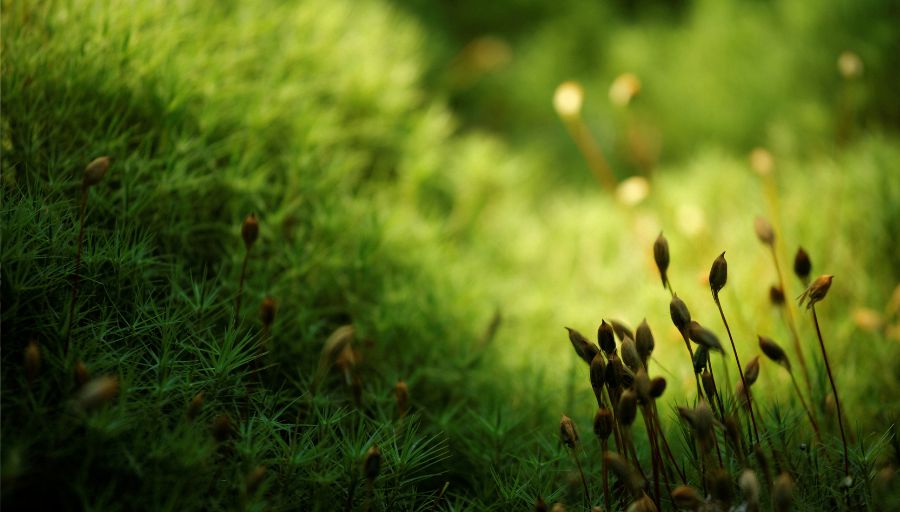
Asexual reproduction through fragmentation can happen when an animal steps on the plant or the wind breaks the plant in two. The fragment is a clone of the mother plant and can grow into a new plant. This enables it to colonize large areas at an amazing pace.
Haircap is the species we specify where a slope has to hold, from $24.95 a square foot.
Pending review by Olivia Milner, practitioner-scientist with a background in sustainability and education.